【Market Opportunities】Lessons in Cross-Industry Growth and Strategic M&A from Midea's Transformation
Date: 10/29/2026 12:00:00 AM
Introduction
As exchanges between Advantech and Midea Group deepen in strategic investment and industry collaboration, Midea's transformation offers growth strategies worth examining. In this issue of Market Insights, we use Midea as a case study to explore how it evolved from a traditional home appliance company into a global industrial technology group through cross-border acquisitions, internal incubation, and technology integration, and consider the implications for Advantech's future industry positioning and investment-driven co-creation.
Midea Group — From Home Appliance Giant to Global Industrial Technology Group
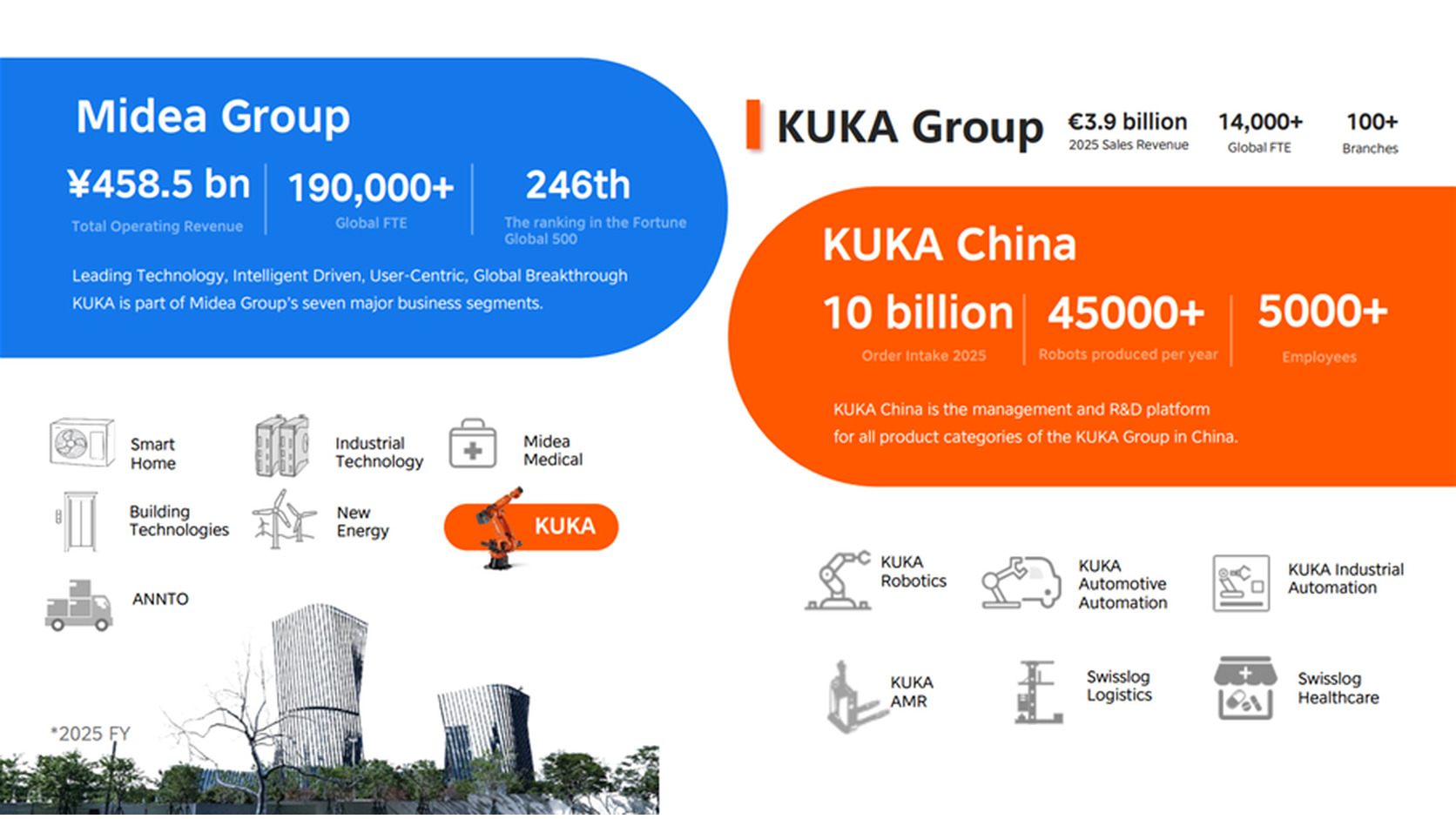
Founded in 1968, Midea Group listed on the Shenzhen Stock Exchange in 1993. After professional manager Fang Hongbo took the helm in 2012, the company further accelerated its digital and technology transformation, establishing a dual-engine model of “Smart Home + Industrial B2B.” It also listed on the Hong Kong Stock Exchange in 2024. From its beginnings as a small enterprise, Midea has evolved into a global technology giant ranked among the Fortune Global 500.
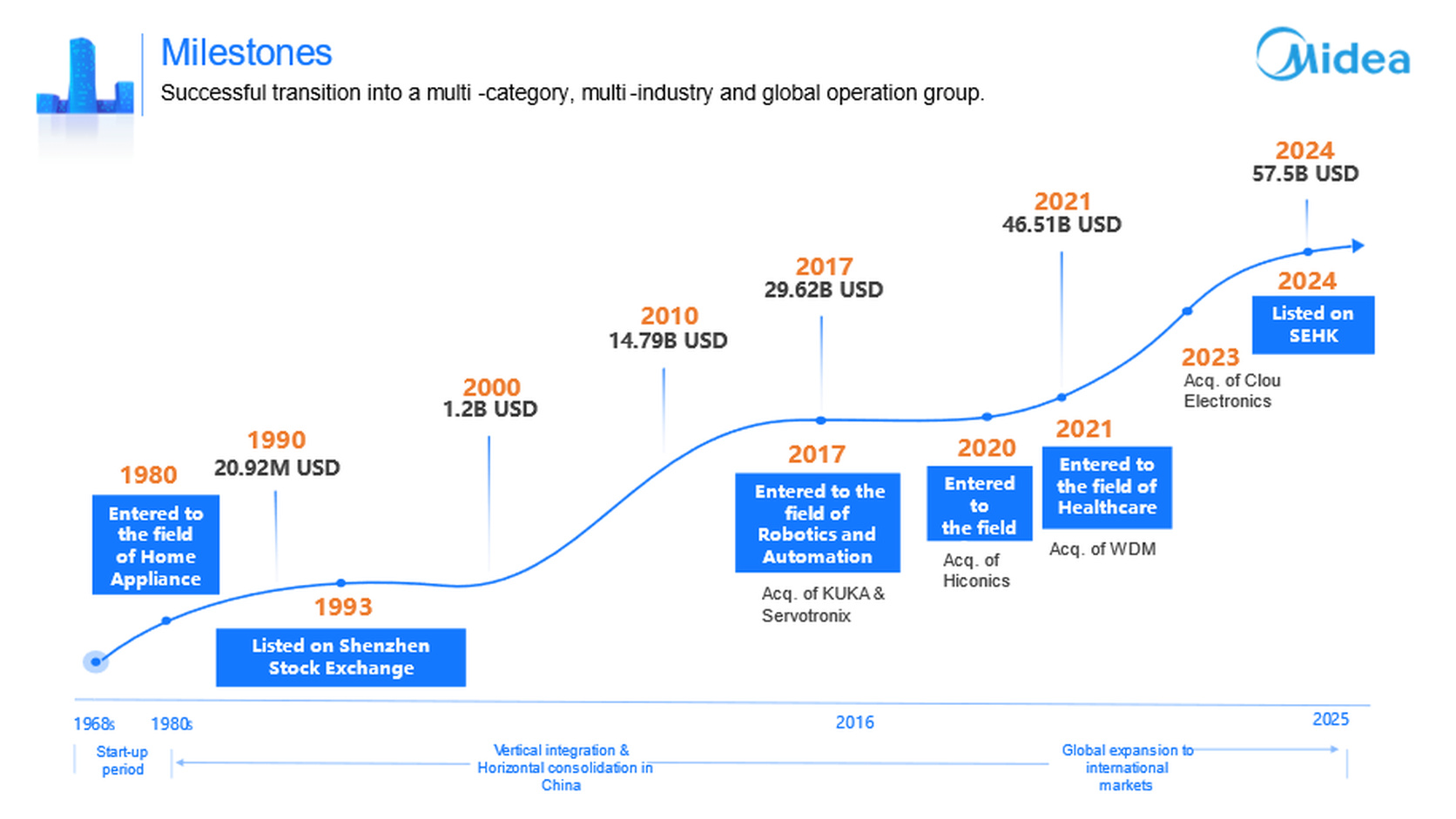
Three Stages of Midea Group's Transformation: Scaling Up → Globalization → Technology Transformation
At each stage, Midea pursued internal organizational reform and incubation alongside cross-border acquisitions. This dual-track approach helped it break away from the low-margin constraints of traditional assembly and contract manufacturing and gradually expand beyond home appliances into industrial automation, smart buildings, healthcare, new energy, and smart logistics, developing into an international technology group spanning multiple brands and industries.
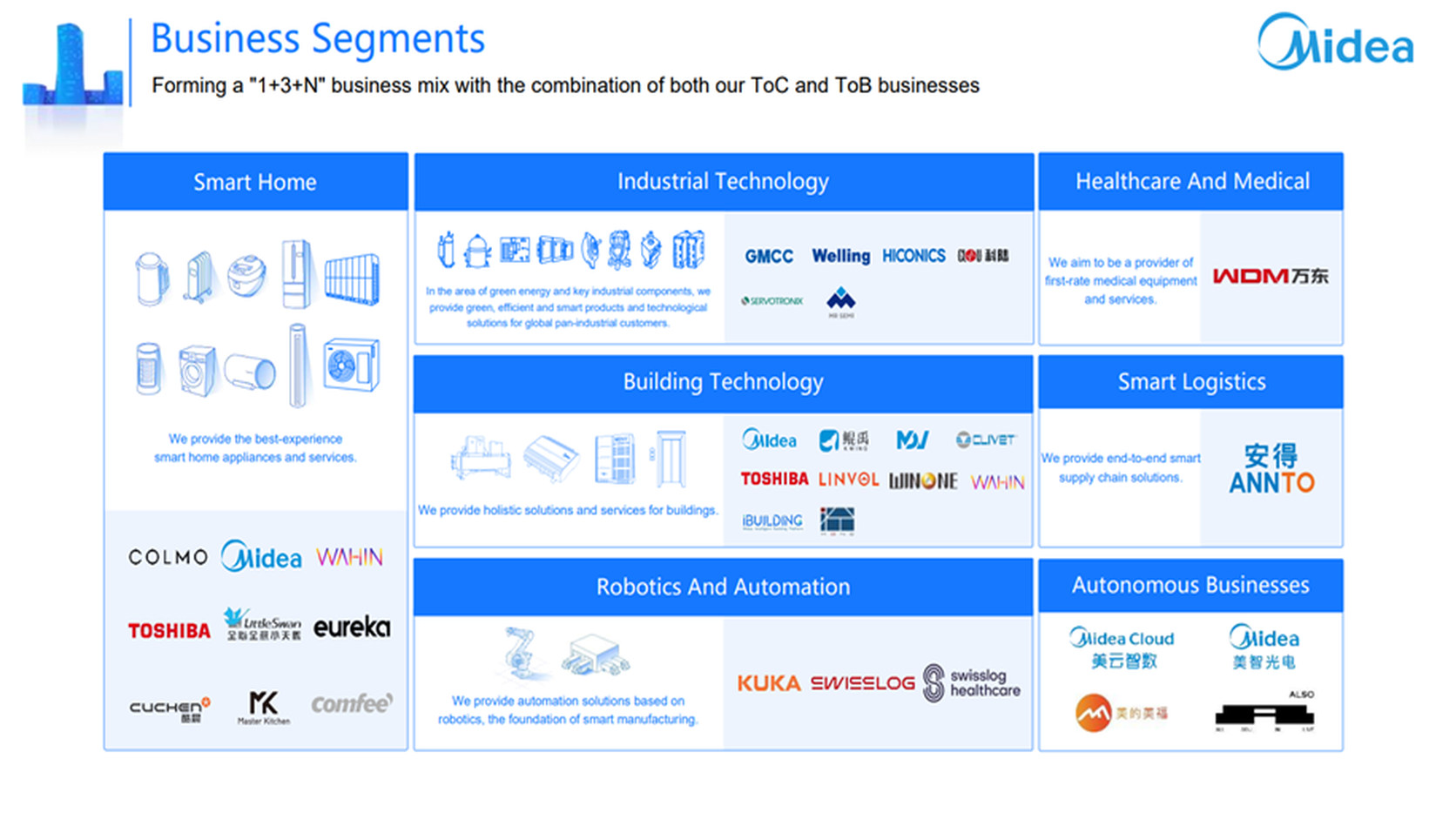
Midea Group — M&A as a Growth Engine
Midea's cross-industry expansion has involved more than simply adding revenue streams. Its transaction history shows that acquisitions have continuously brought in technologies, product platforms, overseas markets, and industry applications, enabling the group to expand from home appliance manufacturing into multiple B2B verticals.
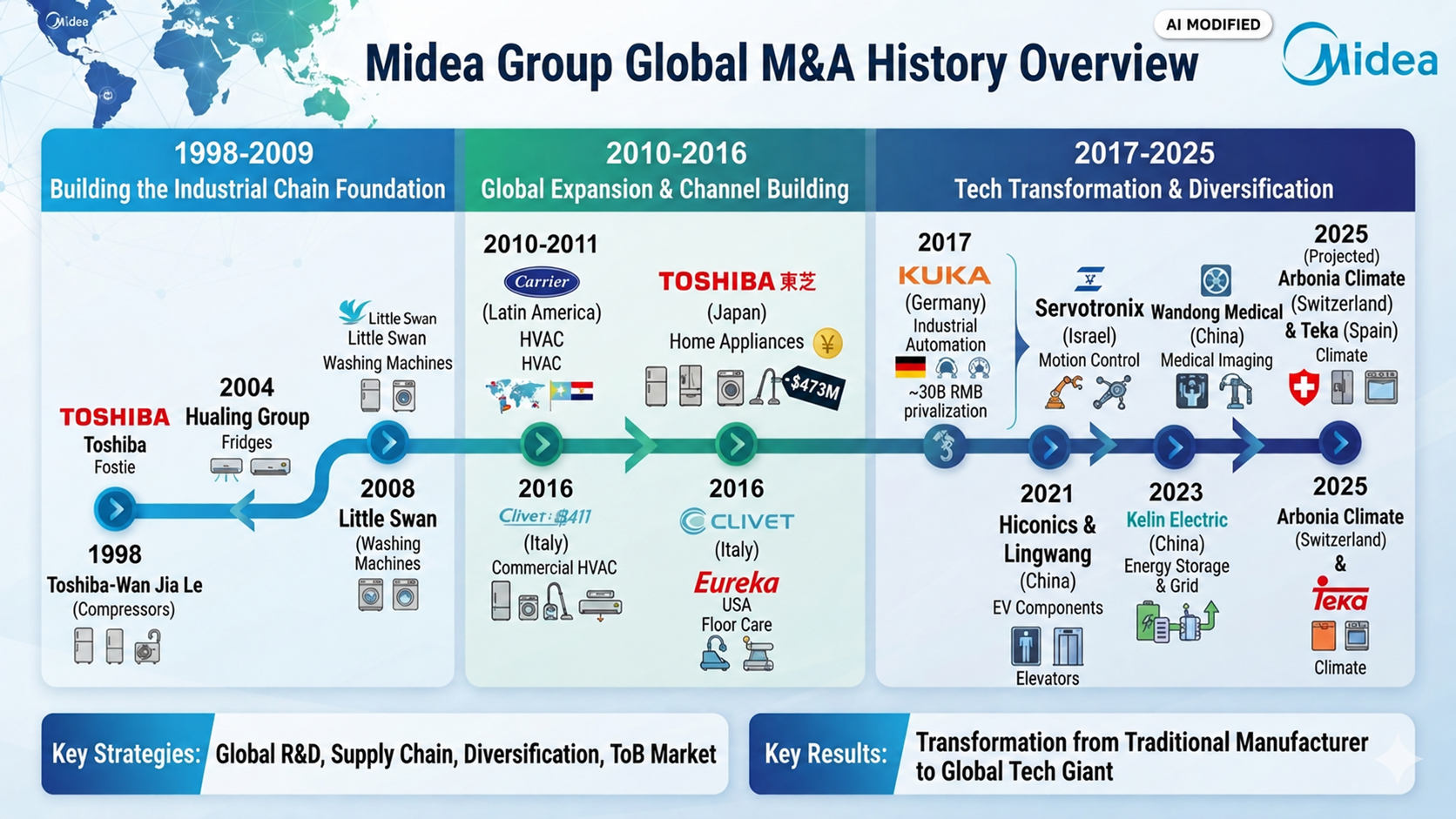
Looking at its current business portfolio, Midea has established several B2B platforms with room for independent expansion. These platforms share a need to integrate equipment, computing, connectivity, software, and industry-specific applications, creating potential areas of industry collaboration for Advantech to evaluate further.
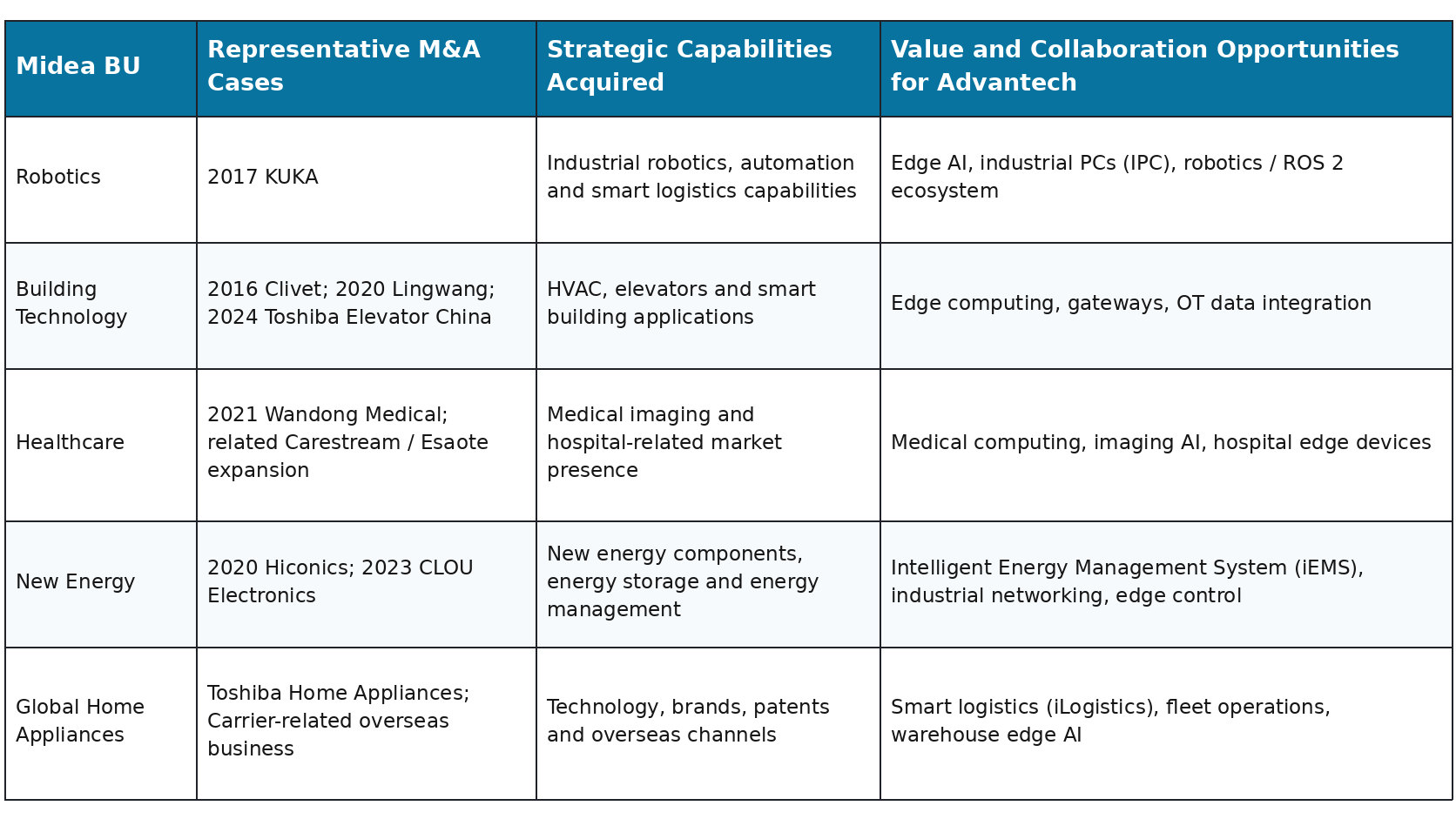
Midea Group's Representative International Acquisition in Industrial Automation — KUKA
Founded in Germany in 1898, KUKA is one of the “big four” families in industrial robots and factory automation solutions worldwide. Since Midea Group acquired it in 2017, KUKA has become one of the group's most important businesses in industrial automation and embodied intelligence. Its products are no longer limited to traditional heavy-payload robots but have expanded into areas including AGVs and MRs, warehouse robots, and humanoid robots. With the arrival of Industry 4.0 and the era of AI-driven robotics, KUKA and Advantech have numerous opportunities for strategic ecosystem collaboration.
Midea Group — Representative Internal Incubation Case: ANNTO
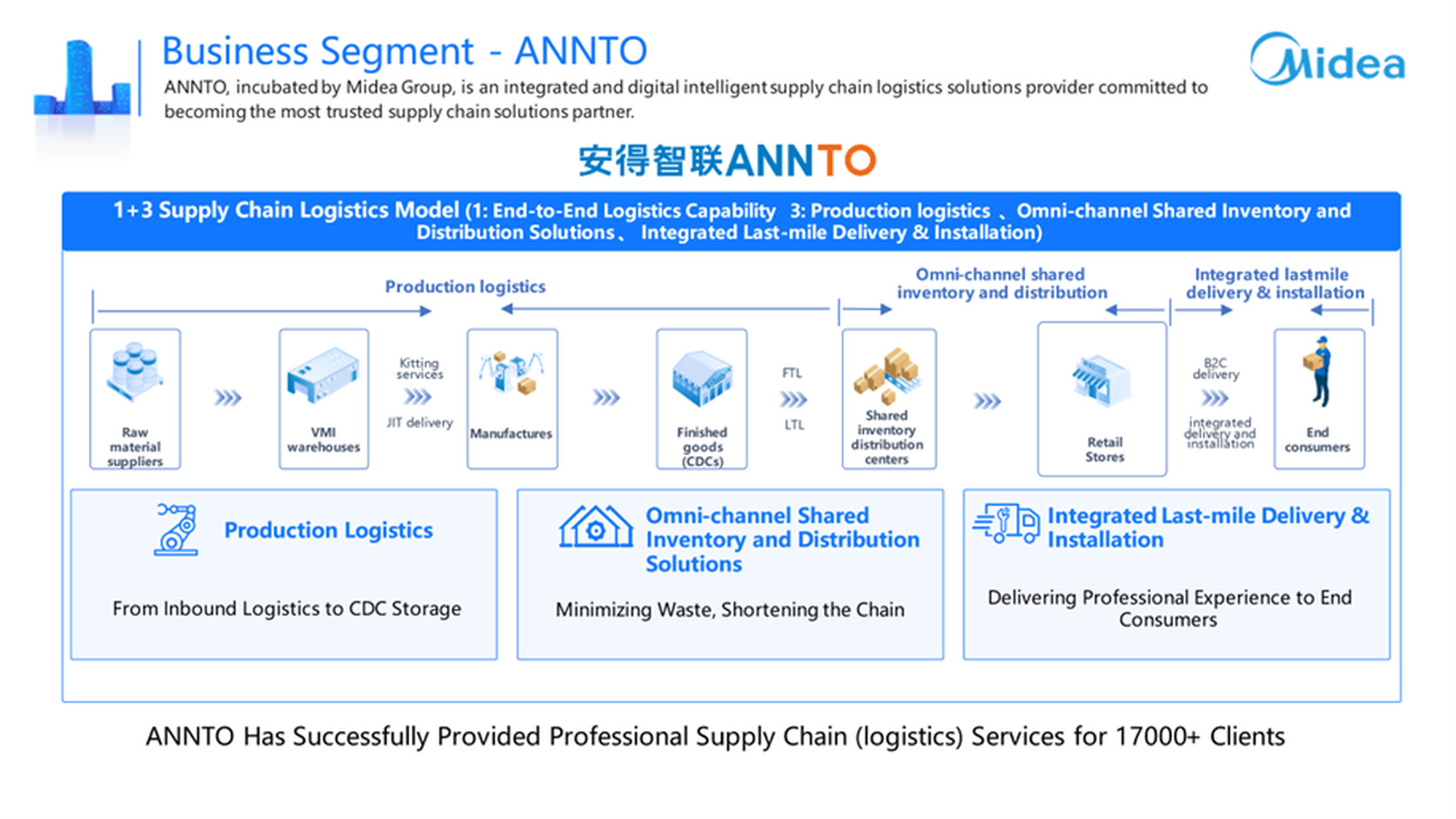
In addition to external acquisitions, Midea has created new growth platforms through internal incubation. Although ANNTO was incubated within Midea, it has expanded from serving internal group needs into the external supply-chain logistics market, with a core management team demonstrating a strong entrepreneurial spirit. In 2025, it recorded revenue of RMB 21.5 billion and net profit exceeding RMB 449 million, serving more than 13,000 external enterprise customers. Based on 2025 revenue, it was the largest integrated supply-chain logistics solutions provider in China's home appliance industry and ranked first by revenue among production logistics solutions providers in China. It filed for an IPO in Hong Kong's capital market in 2026.
In May 2026, ANNTO implemented an unmanned delivery project at Midea's small-home-appliance factory in Shunde, with autonomous vehicles operating independently and docking precisely. The model has now been validated at Midea's factories in Shunde, Hefei, and Wuxi. Across Midea's global factory campuses, there is potential demand for the deployment of more than 6,000 unmanned vehicles. Automated warehousing solutions have also been implemented at Midea factories. Goods are transferred via conveyors and rail-guided vehicle (RGV) circular shuttles, then automatically placed into storage by stacker cranes. During outbound operations, RGVs transfer goods seamlessly, with AGVs carrying them onward to shipping platforms. For loading and unloading, an automated solution centered on unmanned forklifts has been deployed. Through deep coordination among WMS, WCS, and RCS systems, the entire palletized unloading process is automated.
A Key Collaboration Case Between Midea and Advantech — Healthcare
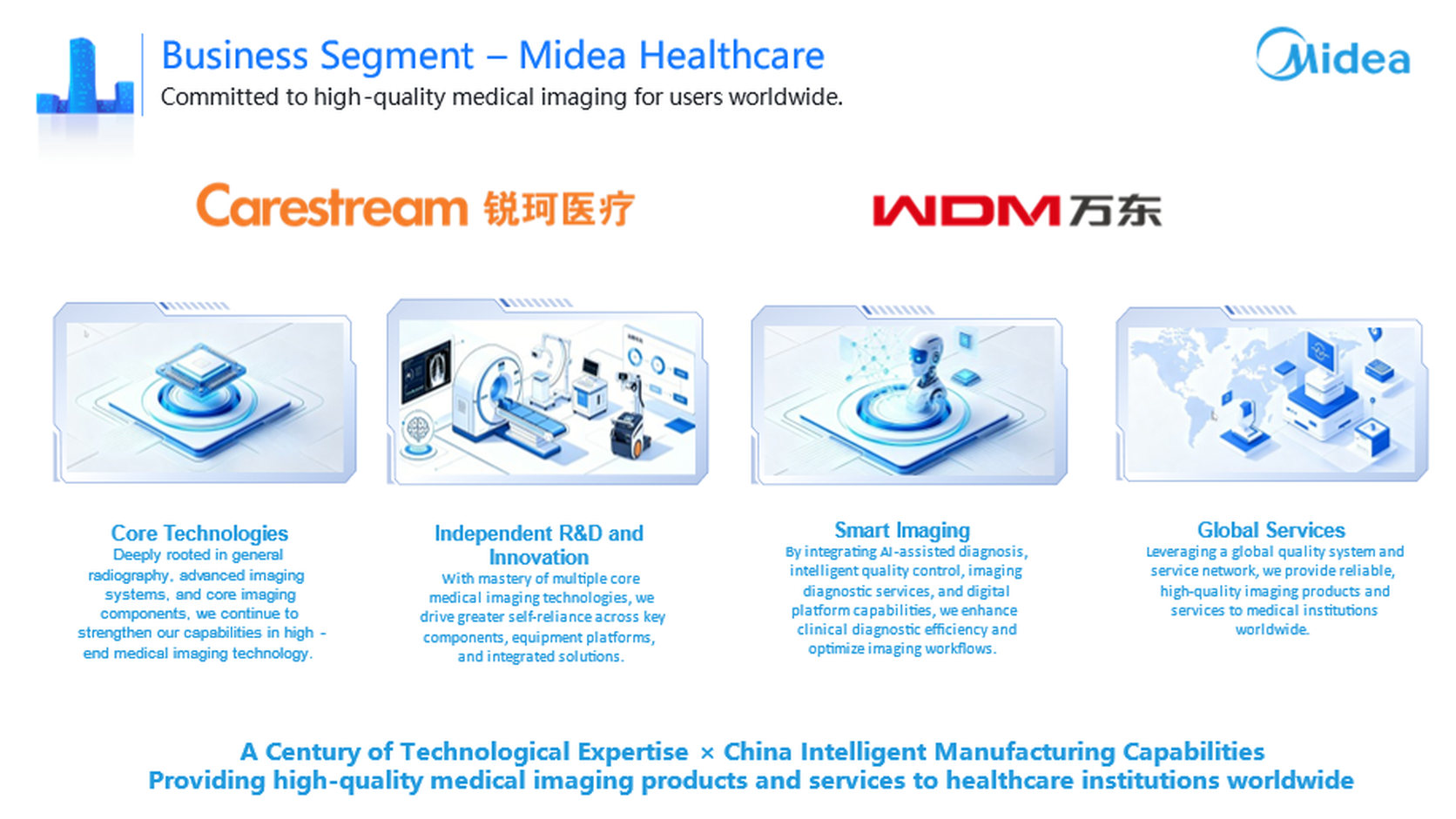
Midea Healthcare has been a major strategic business in Midea Group's recent technology-driven transformation toward B2B markets. Through cross-border acquisitions and resource integration, it brings together Wandong Medical (diagnostic imaging), Swisslog Healthcare (in-hospital logistics), KUKA (surgical automation), Midea Biomedical (smart cold chain), and building technologies. Its core blueprint comprises solutions for five major settings: medical technology buildings, surgical departments, outpatient pharmacies, inpatient wards, and logistics command centers. It collaborates with more than 3,000 large hospitals worldwide.
Wandong Medical and Advantech have collaborated on medical imaging computing platforms since 2019. Advantech provides high-reliability, high-computing-performance edge computing systems with long product life cycles to support image acquisition, processing, and AI-assisted diagnosis; Wandong integrates these computing platforms into its medical imaging equipment. On April 9, 2025, at the China International Medical Equipment Fair (CMEF), the two companies and Midea Central Research Institute jointly unveiled the “Super Matrix” end-to-end AI intelligent computing platform for magnetic resonance equipment, applying AI to imaging quality, scanning workflows, and clinical diagnosis.
【Note: Some images on the original webpage were provided by Midea Group. 】
